Collagen production: did you know Radiofrequency effectiveness depends on temperature?
Learn how temperature directly influences the effectiveness of Radiofrequency in collagen production and in the results of aesthetic treatments.


Learn how temperature directly influences the effectiveness of Radiofrequency in collagen production and in the results of aesthetic treatments.
Published on August 5, 2025
Did you know that the effectiveness of Radiofrequency in stimulating collagen is directly tied to the temperature reached in the deeper layers of the skin?
To activate the production of collagen, which is responsible for skin firmness and elasticity, the heating must be controlled and reach stable levels, without damaging the surface.
Keep reading to learn more!
Radiofrequency has gained prominence among aesthetic treatments for combining efficiency, safety and versatility.
Unlike invasive procedures, Radiofrequency works through controlled heating of the inner layers of the skin, promoting stimuli that improve the clinical signs of rejuvenation.
All of this without harming the skin surface or requiring recovery periods. In addition, this technology can be applied to different areas of the body and face to treat:
• Signs of aging and skin laxity;
• Localized fat;
• Fine lines and wrinkles;
• Skin rejuvenation;
• Acne scars;
• Cellulite and other unwanted skin concerns.
Because it adapts to different protocols and needs, Radiofrequency has become a strategic choice in aesthetic clinics.
However, to achieve the intended results, you need to pay attention to temperature variation during the treatment. That is what we will talk about next.
The temperatures used in Radiofrequency vary according to the goal of the treatment, since different thermal levels and application depths make it possible to address specific dysfunctions.
According to an article published in the Multidisciplinary Scientific Journal (RECIMA21), Radiofrequency applied at elevated temperatures of around 40 °C increases collagen density during treatment.
This temperature directly contributes to improving skin laxity. For this reason, this thermal range is recommended for treating tissue laxity, making it an effective, non-invasive alternative in aesthetics.
Higher temperatures, such as 42 °C, are recommended for localized fat reduction, according to another study published by Centro Universitário ICESP.
Therefore, correctly adjusting the thermal level according to the condition being treated is essential to achieve effective and safe results, whether the goal is to stimulate collagen production, combat skin laxity or reduce localized fat.
Among Non-Ablative Radiofrequency technologies, meaning those that heat the inner layers of the skin without causing surface lesions, two main types stand out: monopolar and bipolar.
The choice between them depends on the treatment goals and the depth you want to reach in the tissues, and Tonederm equipment uses both types of tip. Read on below.
The Monopolar Tip, used in facial and body treatments, delivers deeper heating to the tissues. It has a single active electrode and requires a return plate placed on another area of the body.
This way, the electric current reaches a greater depth, which is ideal for treatments that require remodeling in deeper layers of the skin.
This method is recommended, for example, to treat localized body fat (including localized fat in the double chin area).
Bipolar Radiofrequency (Hexapolar Tip)
With the Bipolar Tip, the current flows from one electrode to the other, eliminating the need for a return plate and acting more superficially.
Níoo has two hexapolar tips that use Bipolar Radiofrequency: a larger one, recommended for body treatments (such as skin laxity and flaccid cellulite), and a smaller one, specially designed for facial applications.
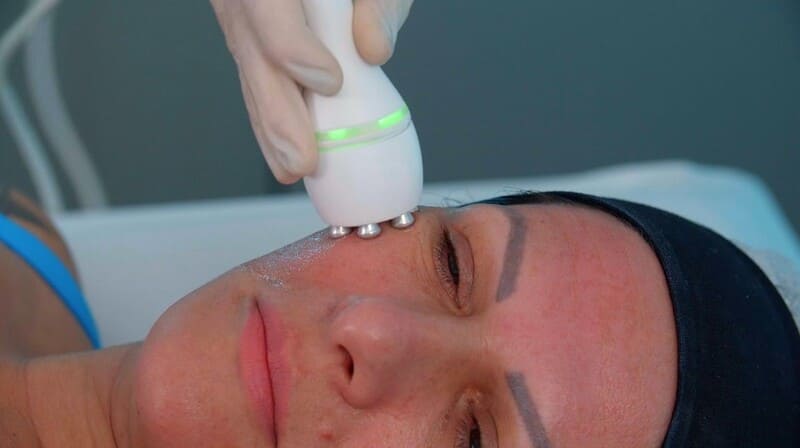
Facial Hexapolar Handpiece for collagen stimulation.
During a Radiofrequency session, the correct, stable temperature determines whether the treatment will be effective and safe.
If the temperature is below the ideal (usually between 40 °C and 42 °C, depending on the treatment), the therapeutic effects are reduced. On the other hand, if it exceeds safe limits, there is a risk of discomfort, burns or tissue damage.
That is why the automatic temperature control found in the Níoo Colagen Module is a differentiator: the system adjusts the power to keep the heating stable and uniform, according to each patient's skin characteristics.
This thermal care ensures:
• Better aesthetic results;
• Greater patient comfort;
• Greater procedure safety;
• Total control for the specialist.
In this way, thermal control allows the professional to focus on carrying out the treatment and customizing the protocol.
Keep following the Tonederm blog for more tips about the fascinating world of regenerative and aesthetic medicine.
Receive the latest news from Tonederm