Myths and Facts About Fractional and Conventional Radiofrequency
Discover the myths and facts about fractional and conventional radiofrequency and learn how effective and safe these aesthetic treatments are.


Discover the myths and facts about fractional and conventional radiofrequency and learn how effective and safe these aesthetic treatments are.
Published on December 4, 2024
Radiofrequency is a technology widely used in aesthetic treatments because of its effectiveness in improving the clinical signs of rejuvenation, as well as in body procedures. Because it is an area that keeps gaining popularity, many doubts and misconceptions still surround this technology.
Tonederm, at the forefront of technologies for aesthetic treatments, prepared this article to help professionals better understand how to apply radiofrequency and its benefits.
The goal is to address the main myths and facts about fractional radiofrequency and conventional radiofrequency.
Shall we get started? Keep reading!
Energy is emitted along the entire length of the needles, ensuring uniform and efficient distribution during the treatment. This means the heat generated by radiofrequency is applied evenly at every contact point.
These needles are gold-plated, which, besides being hypoallergenic, increases electrical conductivity. This coating allows the energy to flow consistently.
The Colagen Module, from the Níoo, uses this technology with extremely precise needles. It enables personalized treatments with 6 different depths, adjustable from 0.5 mm to 3 mm.
This technology combines the physical effects of microperforation with heat generation, supporting treatments such as improving the clinical signs of rejuvenation and improving skin texture and elasticity.
In this way, fractional radiofrequency stands out for creating microchannels in the skin while heating the deeper layers, stimulating collagen and promoting cell regeneration.
In addition, the microchannels increase skin permeation, making it easier to absorb the cosmetic actives applied after the procedure, a technique known as Drug Delivery. The result is skin with greater elasticity, an even texture, glow, and fewer fine lines and wrinkles.
The Colagen module, from the Níoo Station, uses fractional radiofrequency to efficiently combine thermal and ablative effects.
The depth options (0.5 mm to 3 mm) of the electrodes on the matrix fractional handpiece make treatments highly adjustable to the needs of each patient and body area. The adjustable depths allow radiofrequency energy to reach different layers of the skin, delivering precise and controlled stimulation.
Treatments can be personalized, optimizing results and broadening clinical indications. This flexibility is especially valuable for professionals who want to serve a diverse range of patients, each with specific needs.
The fractional electrodes have fixed depths, which allows for precise and personalized control. Therefore, contrary to what some may think, it is not robotic.
This manual approach offers the flexibility to treat different conditions and areas of the body and face, adjusting the needle penetration depth according to the goal of the treatment.
For example, more delicate areas may require a shallower depth, while regions with thicker skin may need deeper adjustments.
The high power and the pulse programming system optimize the application, resulting in quick, highly effective procedures.
The high power makes it possible to reach ideal temperatures in the dermis uniformly and in less time. This factor is essential because it promotes:
• Immediate contraction of existing collagen, which, as early as the first sessions, results in improved skin firmness (tightening);
• Accelerated stimulation of collagen and elastin production, providing continuous rejuvenation in the weeks following the treatment.
The pulse programming system allows the professional to adjust the application mode, the energy and the interval between pulses during the procedure.
With a small, sensitive tip, it is indicated for smaller, hard-to-reach regions, such as the glabella, barcode lines and the periorbital area.
The linear handpiece delivers controlled and uniform energy, minimizing the risk of discomfort or adverse effects in areas with thinner skin.
The small tip of the linear handpiece makes it easier to reach smaller areas, where control and precision are essential.
These regions require equipment that allows localized applications without energy dispersion.
When treating smaller areas, the linear handpiece softens fine wrinkles and improves the appearance of areas that age early because of constant movement, such as the eyes and mouth.
Although fractional radiofrequency is a versatile and effective technology for many aesthetic treatments, it is not recommended for melasma, because the heat generated can worsen the condition, even with localized applications.
Melasma is a condition that involves increased melanin production in the skin, often triggered by thermal stimuli. Fractional radiofrequency, by generating heat in the deeper layers of the skin, can intensify the pigmentation process.
Even with localized applications, heating the skin can provoke an inflammatory response that stimulates melanin production, leading to post-inflammatory hyperpigmentation in people with melasma.
The needles penetrate automatically through the emission of energy, with no additional effort required from the professional.
The microneedles are designed to penetrate the skin by means of electromagnetic pulses, which drive the needles with precision. This process happens quickly and in a controlled way, without requiring any additional physical effort from the operator.
The professional chooses the desired depth (from 0.5 mm to 3 mm, for example), and the equipment ensures that the needles reach exactly that layer of the skin, with no variations or inconsistencies.
During the pulse, energy is released evenly through the needles, maximizing the effects of the treatment.
Gold, besides being hypoallergenic, optimizes electrical conductivity, increasing the safety and efficiency of treatments.
It is not just an aesthetic choice, but a functional solution.
With the gold coating, each contact point receives the precise dose of heat needed to stimulate collagen and promote skin regeneration, providing important benefits for aesthetic procedures.
Because gold is a noble metal, it is a material more inert to oxidation. Since the work involves electrical current in an ionic medium, due to the body's fluids, gold resists better and extends the useful life of the needles during application.
It is important to remember that the electrodes, both fractional and linear, are single-use and disposable.
With hexapolar and monopolar tips, conventional radiofrequency is indicated for reducing measurements, skin laxity and cellulite, without causing microperforations in the skin.
Conventional radiofrequency uses electromagnetic waves to heat deeper tissues, without pain or discomfort.
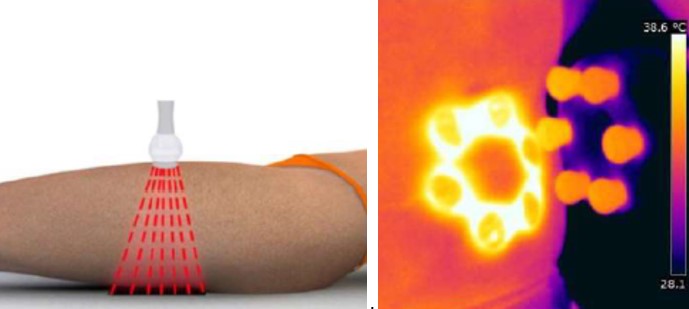 Monopolar Handpiece and Hexapolar Handpiece
Tonederm's equipment uses different types of tips in conventional radiofrequency to meet the specific needs of each treatment: the hexapolar (bipolar) tip and the monopolar tip.
Monopolar handpieces are indicated for treatments that aim to produce deeper heating in the tissues. These handpieces have only the active electrode and require a dispersive electrode, or return pad, which must be placed in a region outside the plane of the treated area.
In this way, the high-frequency currents need to penetrate deeper into the tissue to reach the return pad or dispersive electrode. This electrode does not heat up, because it has a large contact area that prevents current concentration, unlike what happens with the active electrode.
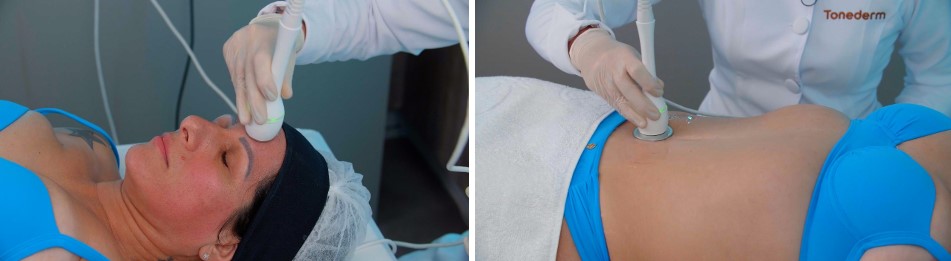
Facial Monopolar and Body Monopolar
The hexapolar handpiece is actually a bipolar applicator with 3 pairs of electrodes, and it does not require a dispersive electrode. Since all 3 pairs of electrodes are positioned on the same side of the tissue, the current does not need to penetrate as deep into the tissue.
Since all the electrodes have the same contact area and are all small, they produce current concentration in their vicinity, which is why all of them are called active electrodes and produce heat. This handpiece is highly recommended for more superficial skin work, and it has excellent heating capacity to produce skin tightening.
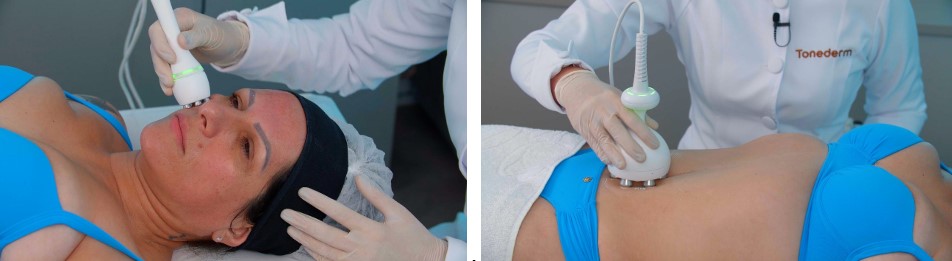 Facial Hexapolar and Body Hexapolar
This technology uses ionized gas to generate chemical and thermal effects, making it ideal for spot treatments.
This approach makes it possible to precisely treat small, delicate areas, promoting skin tightening and improving the clinical signs of rejuvenation, such as softening wrinkles and fine lines.
The heat generated by the plasma causes the collagen fibers in the superficial layer of the skin to contract, resulting in an immediate "lifting" effect.
Plasma Jet technology is present in the Colagen Module. Tonederm has the only Plasma Jet generated by radiofrequency, producing a more stable plume.
This module has three technologies available in total:
• Conventional radiofrequency: uses electromagnetic waves to heat deeper tissues;
• Microneedled radiofrequency: uses gold-plated microneedles to apply heat to all layers of the skin.
• Plasma Jet: a technology that uses ionized gas, made up of reactive molecules, free electrons and light radiation, to produce chemical and thermal effects in the tissues.
Thus, the Colagen allows multiple treatments in a single solution, paired with the Cérebro of the Níoo Station. The Colagen Module stands out for its portability and versatility.
The integrated thermometer ensures that the desired temperature is reached, and the automatic power control ensures that it is maintained, allowing greater safety and precision in procedures. The monitoring reduces the risk of discomfort during the treatment, according to each patient's skin conditions.
The system adjusts the power delivered by the handpieces so that heating is uniform across the entire treated area, ensuring a more comfortable procedure with better aesthetic results.
This intelligent system maximizes results by adjusting parameters automatically, ensuring consistency throughout the entire procedure.
Power is controlled continuously to ensure that the ideal level is applied to the skin, avoiding too much or too little heat, which maximizes effectiveness and minimizes risks.
Professionals can focus on technique while the equipment takes care of the settings, making the procedure quicker and more comfortable.
The conventional radiofrequency electrodes for diathermy are covered by a protective insulating layer called ThexCoat (Thermal Exchange Coat). This protection is responsible for the efficient electrical insulation of the electrodes, preventing high concentrations of electrical current that can cause anything from patient discomfort to skin burns.
Because of this protective layer, the electrical coupling of radiofrequency for diathermy is said to be capacitive and depends on physical contact over a wide area to transfer energy to the tissue. For this coupling to be efficient, glycerin must be used as the interface fluid between the electrodes and the skin.
This technology, ThexCoat, ensures a more comfortable application for the person receiving it.
Radiofrequency, whether in its fractional or conventional form, is a well-established technology in the world of aesthetic treatments, capable of delivering safe and effective results.
Throughout this article, we explored the main myths and facts about these techniques, clearing up common doubts and highlighting the advantages they offer.
As we saw, the use of advanced technologies, such as those found in Tonederm's Níoo Station modules, broadens treatment possibilities, allowing professionals to personalize each procedure to meet their patients' individual needs.
Tonederm reaffirms its commitment to bringing innovation and quality to the aesthetics market, helping clinics and professionals offer treatments that combine technology and proven results.
Keep following the Tonederm blog for more useful information about the fascinating world of regenerative medicine and aesthetics.
Content you may be interested in:
• 5 tips to help your patient overcome the fear of aesthetic procedures
• Understand the benefits of Fractional Radiofrequency and its combinations for aesthetic health
• Summer project: how to integrate technologies to optimize body aesthetic results?
Receive the latest news from Tonederm